
The Home Care Worker Immigration Pilots are some of the most effective ways for skilled caregivers to gain permanent residency in Canada. They aim to meet the growing demand for in-home care. These pilots offer foreign workers a straightforward path to settle in Canada while supporting families and communities. Immigration, Refugees and Citizenship Canada (IRCC) runs the program, which targets labor shortages in child care and home support services. It enables qualified caregivers to gain Canadian work experience and find a way to permanent residency.
WikiVisa Canada is a trusted source for immigration advice. They have created this guide to help potential applicants understand the Home Care Worker Immigration Pilots. This guide includes eligibility criteria, application processes, and the benefits of joining the program. Whether you are a caregiver looking to move to Canada or a family wanting to hire a skilled worker, this guide provides all the information you need to navigate the program.
Attention: Detailed Appendix Notice
Due to the extensive data, regulatory analysis, and procedural explanations in this article on Home Care Worker Immigration Pilots, each section is accompanied by a dedicated appendix. These appendices include the extended version of every section, offering in-depth interpretations, background information, and complete documentation details.
Readers who wish to understand the full scope of the Home Care Worker Immigration Pilots, including policy frameworks, eligibility specifications, and implementation case studies, are encouraged to consult the appendix sections following each summary.
Introduction to Home Care Worker Immigration Pilots
The Home Care Worker Immigration Pilots are an important part of Canada’s immigration and labor strategy. Immigration, Refugees and Citizenship Canada (IRCC) launched these pilots to tackle the country’s serious shortage of professional caregivers. Through the Home Child Care Provider Pilot (HCCP) and the Home Support Worker Pilot (HSWP), qualified foreign nationals can work in Canada, gain valuable experience, and move towards Permanent Residency (PR) while assisting families who need in-home care for children, seniors, and people with disabilities.
These updated pilots replaced the old Live-In Caregiver Program (LCP). They provide more flexibility by removing the Labour Market Impact Assessment (LMIA) requirement, allowing participants to switch employers more easily and supporting family reunification. In addition to filling labor gaps, the program shows Canada’s humanitarian values by promoting fairness, stability, and opportunity for caregivers. This makes the Home Care Worker Immigration Pilots both an important economic solution and a socially responsible immigration model.
Appendix A: Introduction to Home Care Worker Immigration Pilots
The Home Care Worker Immigration Pilots are one of the biggest pathways created by the Government of Canada to address the country’s caregiver shortage. Designed and managed by Immigration, Refugees and Citizenship Canada (IRCC), these pilot programs were introduced to provide a structured and fair way for foreign nationals to work and settle in Canada as caregivers. They are part of Canada’s long-term immigration and labour strategy to balance family needs, support vulnerable populations, and strengthen the national healthcare system.
Canada’s demographics have changed dramatically over the past few decades. With an aging population and more households requiring in-home care for children, elderly family members, and individuals with disabilities, the demand for professional caregivers has exceeded what the domestic labour market can supply. The Home Care Worker Immigration Pilots, which include the Home Child Care Provider Pilot (HCCP) and the Home Support Worker Pilot (HSWP), were created to fill this gap by allowing skilled foreign caregivers to come to Canada, gain valuable work experience, and eventually qualify for Permanent Residency (PR).
These programs replaced the old and less efficient caregiver programs, such as the Live-In Caregiver Program (LCP), introducing more flexible and worker-friendly policies. For example, the new pilots allow participants to change employers more easily, bring their family members to Canada, and work without the traditional Labour Market Impact Assessment (LMIA) burden that limited access in previous programs. This reflects IRCC’s recognition that caregivers are essential to Canada’s social and economic stability.
Beyond workforce support, the Home Care Worker Immigration Pilots have a humanitarian and community dimension. They help Canadian families find trustworthy care providers and give foreign workers a better life, long-term stability, and a clear path to citizenship. This balanced approach makes the program not only a labour solution but also a socially responsible immigration model aligned with Canada’s values of inclusion, fairness, and opportunity.
In the following sections, this comprehensive guide will cover everything about the Home Care Worker Immigration Pilots, from eligibility criteria and application process to work permit conditions, permanent residency pathways, and future policy directions. Whether you are a caregiver looking to build your career in Canada or an employer looking to hire home care professionals, this detailed overview will give you all the information you need to understand and navigate the program.
Main Streams under the Home Care Worker Immigration Pilots
- Home Child Care Provider Pilot (HCCP): For caregivers who provide professional in-home child care, ensuring safety, supervision, and developmental support for children.
- Home Support Worker Pilot (HSWP): For caregivers assisting seniors and individuals with physical or cognitive disabilities through daily living support, companionship, and household care.
Table of Home Child Care Provider Pilot & Home Support Worker Pilot Comparison
Feature | Home Child Care Provider Pilot (HCCP) | Home Support Worker Pilot (HSWP) |
Primary Focus | Childcare and developmental support | Elderly and disability support |
Typical Clients | Children under 18, families with young dependents | Seniors, adults with physical or cognitive limitations |
Work Environment | Private homes or family care settings | Homes, assisted living, or private residences |
Core Responsibilities | Supervision, education support, safety, and emotional well-being | Companionship, personal assistance, medication reminders, and household tasks |
Path to PR | 12 months of eligible full-time work before applying | 12 months of eligible full-time work before applying |
Work Permit Type | Occupation-restricted open work permit | Occupation-restricted open work permit |
? Appendix B: What Are the Home Care Worker Immigration Pilots
The Home Care Worker Immigration Pilots are specialized immigration programs introduced by the Government of Canada through Immigration, Refugees and Citizenship Canada (IRCC) to create a clear and fair pathway for foreign caregivers to get Permanent Residency (PR) in Canada. These pilots are to meet Canada’s growing need for home-based care providers who can support children, the elderly, and persons with disabilities.
At their core, the Home Care Worker Immigration Pilots are two distinct but related programs:
- Home Child Care Provider Pilot (HCCP) – This stream is for caregivers who provide professional in-home child care. They are responsible for the supervision, safety, and developmental well-being of children in their care, whether in a private household or a family-based care setting.
- Home Support Worker Pilot (HSWP) – This stream is for caregivers who provide in-home support to seniors or individuals with physical or cognitive disabilities. Their duties often include companionship, daily living support, medication reminders, and general household assistance to help clients maintain a safe and comfortable home environment.
Both streams are under the Home Care Worker Immigration Pilots, sharing the same purpose to allow qualified foreign caregivers to come to Canada, get valuable work experience, and transition to PR. The key innovation of these pilots is their two-stage structure, where applicants first get an occupation-restricted open work permit to get Canadian work experience, and upon completion of at least 12 months of eligible full-time employment, they can apply for PR.
The Home Care Worker Immigration Pilots were launched in June 2019 and replaced the outdated Live-In Caregiver Program (LCP). Initially planned as five-year initiatives (2019-2024), both pilots were renewed and extended from 2024 to 2029, as they are successful and the demand for home care professionals across Canada is ongoing. In fact, the IRCC’s decision to continue and enhance these programs shows the government’s commitment to stabilizing the caregiving workforce and ensuring accessible, quality care for Canadian families. As of 2024, the IRCC has also introduced permanent versions of these pilots, simplified the eligibility rules, and the processing. Caregivers no longer need to have a lot of Canadian work experience before applying, and some application barriers have been removed to make the process more inclusive and transparent.
In short, the Home Care Worker Immigration Pilots serve a dual purpose:
they provide foreign caregivers with a dignified and structured immigration pathway and address Canada’s ongoing shortage of skilled care providers. By linking labour market needs with immigration opportunities, these pilots are one of the most progressive and socially beneficial parts of Canada’s immigration system.
Key Aims of the Home Care Worker Immigration Pilots
The Home Care Worker Immigration Pilots were created by Immigration, Refugees and Citizenship Canada (IRCC) to achieve much more than just filling workforce gaps. They represent a long-term vision that supports Canadian families and foreign caregivers. These programs show how immigration and social policies can work together to strengthen Canada’s care system, protect vulnerable groups, and provide fair, steady immigration opportunities for skilled workers.
Aims of the Home Care Worker Immigration Pilots are:
- Addressing national caregiver shortages
- Strengthening family-based and in-home care systems
- Creating fair and clear immigration paths
- Maintaining program integrity through annual caps and targets
Appendix C: Key Aims of the Home Care Worker Immigration Pilots
The Home Care Worker Immigration Pilots were significantly crafted by Immigration, Refugees and Citizenship Canada (IRCC) in response to multiple key national priorities. Those priorities are more ambitious than filling open jobs; they represent the larger social, economic, and humanitarian vision that brings foreign caregivers into the Canadian labor force and ensures the care infrastructure in the country is enhanced.
Program goals show the way immigration policy and social policy can cooperate in order to provide lasting benefits to Canadian families, as well as newcomers with benefits.
1. Meeting National Shortages among Careers in Healthcare
An initial priority of the Immigrant Immigration Pilots is addressing Canada’s longstanding shortage of trained professional caregivers directly. The nation’s demographics are accelerating quickly, as the national data indicate almost one in every five Canadians is currently past the age of 65. Along with the increasing number of dual-waged homes, there is a growing need, both intensive and lasting, for home child caregivers and home support workers.
Supply of domestic labor by itself has not been enough to keep up with this growing demand, especially in the suburbs and countryside, where access is low towards professional care service provision. By launching the Home Child Care Provider Pilot (HCCP) and the Home Support Worker Pilot (HSWP), IRCC maintains a continuous and stable supply of highly trained foreign caregivers who can occupy such critical positions and, in the process, make valuable work and play economic and social contributions towards Canada.
2. In Defense of Family-Based and In-Home
Another essential objective of the Home Care Worker Immigration Pilots is the enhancement of the system of in-home and family-based care in Canada. It is understood by the government that home care is vital in the enhancement of the quality of life among children as well as the elderly. By permitting the provision of comfort by caregivers directly in the homes, public institutions, hospitals, as well as daycare facilities, care is eased, with more individualized care being carried out.
Through these pilots, Canada promotes a style of care that maintains family cohesion, ensures community stability, and upholds the dignity and autonomy of vulnerable segments. It is in tandem with the larger values of Canada, such as compassion, inclusion, and respect for human well-being.
3. Offering Reasonable Immigration Opportunities for Foreign Carers
Traditionally, most caregivers employed in Canada had uncertain prospects and limited hope for settlement. Specifically, the Immigration Pilots for the Home Care Worker were designed to meet these gaps by allowing, through these pilots, clear, transparent, and fair immigration streams. In these schemes, the appropriate caregivers can acquire a work visa and, after accumulating enough experience, acquire Permanent Residency (PR) without a Labor Market Impact Assessment (LMIA).
It ensures that the foreign caregivers would be treated fairly, receive protection under the Canadian labor codes, and be given a real chance to settle into Canadian society with their families. It also protects them from previous problems of exploitation and insecurity that had plagued the previous Live-In Caregiver Program (LCP).
4. Government Targets and Permanent Residency Caps
IRCC administers the Immigration Pilots for the Home Care Worker through annual targets and allocation levels to ensure the broader Canadian immigration system maintains equilibrium. It takes limited fresh applications every year on both the HCCP and HSWP, making sure that the applications can be processed effectively with the allocated resources without jeopardizing the program’s integrity.
In the initial 2019–2024 stream, the cap on intakes was generally at the level of 2,750 pilot/year, which translates into a total of 5,500 principal applicants/year, without the family members accompanying the principal applicants. By the extension into the 2024–2029 stream, the government has shown flexibility in these targets, varying them according to the needs of the Canadian labor market and the demography.
By establishing specific targets and holding the pilots in a state of control, IRCC ensures the pilots remain on track towards generating their desired effect, allowing the provision of sustainable, long-term care solutions and generating equitable opportunities for skilled foreign workers to establish permanency in Canada.
Eligibility Requirements for Applicants in The Home Care Worker Immigration Pilots
The Home Care Worker Immigration Pilots have clearly defined eligibility requirements to ensure that only qualified and capable caregivers can participate and contribute effectively to Canada’s care sector. These requirements are designed by Immigration, Refugees and Citizenship Canada (IRCC) to evaluate an applicant’s skills, education, language ability, and employment background, while maintaining fairness and accessibility for foreign workers who wish to obtain Permanent Residency (PR) through caregiving work in Canada. Meeting these criteria helps guarantee that caregivers entering Canada can provide high-quality, dependable care and integrate successfully into Canadian society.

Home Care Worker Immigration Pilots Applicant’s Requirements are:
- Work Experience: At least 12 months of full-time paid work experience in an eligible caregiving occupation (NOC 44100 – Home Child Care Provider or NOC 44101 – Home Support Worker). Applicants who do not yet have this experience may qualify under the Gaining Experience Category.
- Job Offer: A valid, full-time job offer from a Canadian employer outside Quebec in either child care or home support, demonstrating a genuine need for in-home caregiving services.
- Education: Completion of at least one year of post-secondary education (Canadian or foreign equivalent). Foreign credentials must be supported by an Educational Credential Assessment (ECA) report.
- Language Proficiency: Minimum language level of CLB 5 (Canadian Language Benchmark) in either English or French, as proven through an approved language test (IELTS, CELPIP, or TEF/TCF).
- Admissibility: Applicants must meet Canada’s standard medical, criminal, and security admissibility requirements.
- Intention to Reside: Must intend to live and work outside the province of Quebec.
- Work Permit Type: Applicants first receive an occupation-restricted open work permit, which allows them to work for any employer in the eligible caregiving occupation while gaining the required Canadian experience.
These eligibility standards ensure that every participant in the Home Care Worker Immigration Pilots is professionally competent, linguistically prepared, and committed to delivering safe, compassionate care while building a permanent future in Canada.
Table of Comparison of Eligibility Requirements for HCCP vs. HSWP
Criteria | Home Child Care Provider Pilot (HCCP) | Home Support Worker Pilot (HSWP) |
NOC Code | 44100 | 44101 |
Target Group | Caregivers for children under 18 | Caregivers for elderly or disabled persons |
Work Setting | Private homes, daycare settings | Private homes, residential facilities |
Education Requirement | High school diploma or ECA equivalent | High school diploma or ECA equivalent |
Work Experience Requirement | 12 months of child care in-home | 12 months of elderly/disabled care in-home |
Language Requirement | CLB 5 (English/French) | CLB 5 (English/French) |
Job Offer Type | Full-time, non-seasonal child care | Full-time, non-seasonal home support |
Live-in Requirement | Optional | Optional |
Appendix D: Eligibility Requirements for Applicants
Being admissible under the eligibility criteria for immigration as a caregiver is the initial and paramount process towards applying successfully under the Immigration Pilots for Home Care Workers. Immigration, Refugees and Citizenship Canada (IRCC) has put in specific, equitable, and reliable criteria in order that all candidate applicants have the credentials, experience, and integrity required to effectively fill the spaces in the Canadian caregiving market.
The Immigration Pilots for Home Care Workers, comprising the Immigration Pilot for Home Child Care Providers and the Immigration Pilot for Home Support Workers, have almost the same eligibility criteria, with slight differences in the terms of work responsibilities and the National Occupational Classification codes. Those conditions are tailored such that the applicants can easily fit into the Canadian work scene, offer quality home-based care, and be in harmony with the national professional and ethical requirements.
The main requirements for eligibility in home caregiver programs are:
1. Criteria on Nationality and Age
There is no nationality-specific restriction under the Home Care Worker Immigration Pilots; any country can apply as long as the other IRCC eligibility criteria are satisfied. Yet, the applicants should be legally admissible in Canada when the immigration act is considered. Though no upper limit is prescribed under the age, the applicants should be no younger than 18 years old and should be able to meet the physical and emotional requirements of caring. Most applicants who have been successful sit between the ages of 22–50, as this is the age group that is often associated with work experience in the field that is applicable and flexibility.
2. Educational Background
In order to be eligible for either the Home Child Care Provider Pilot or the Home Support Worker Pilot, the applicants would have to show at least a Canadian high school graduation or equivalent foreign credential. Foreign credentials should be compared through an Educational Credential Assessment (ECA) by one of the authorized bodies like WES, ICAS, IQAS, or CES.
This mandate ensures that each caregiver is at least educated up to the Canadian standard, enabling them to work effectively and communicate effectively with families and employers.
3. Proficiency in Languages
Fluency in English or French is essential for the caregivers who will work hand-in-hand with Canadian families. Application must be able to reach at least Canadian Language Benchmark (CLB) level 5 in the four skills, reading, writing, speaking, and listening.
Allowed language tests are:
- IELTS General Training (International English Language Testing System)
- CELPIP General (Canadian English Language Proficiency Index Program)
- TEF Canada or TCF Canada for French speakers
4. Work Experience Requirement
Under the Immigration Pilots as the Home Care Worker, the applicants need to show appropriate experience as a caregiver, either before or after immigration, subject to the applicant’s category.
- No previous Canadian work experience is needed for applicants who apply from outside Canada, although they have to demonstrate that they are competent enough with education and experience.
- For in-Canada applicants, AT least 12 months’ work experience on a full-time basis (minimum 30 hours per week) is mandatory in a suitable NOC 44100 (HCCP) or NOC 44101 (HSWP) occupation to migrate from temporary residency back to permanent residency.
Experience should have been gained in the last 36 months and should have included in-home care responsibilities befitting IRCC’s work descriptors. It should be paid, regular, and documentable work with accompanying reference letters and work history.
5. Valid Job Offer Conditions
A valid job offer is a cornerstone of the Home Care Worker Immigration Pilots application process. Immigrant applicants need to secure a full-time non-seasonal work offer through a Canadian-based employer who is non-resident in Quebec. The offer should:
- Clearly state caregiving duties corresponding to either HCCP or HSWP;
- Be made by a single employer (not through an agency);
- Demonstrate a genuine need for in-home care;
- Not require the caregiver to live in the employer’s home (live-in arrangements are optional).
Significantly, the pilots are LMIA-exempt, which entails that the employers will not be required to acquire a Labour Market Impact Assessment, a significant enhancement compared to earlier caregiver plans. This facilitates a quicker and easier hiring process among applicants and employers.
6. Admissibility and Background Check
All applicants will be admissible to Canada under the Immigration and Refugee Protection Act. This entails:
- Medical examinations to confirm good health and ability to perform caregiving tasks;
- Police clearance certificates from all countries where the applicant has lived for six months or more since age 18;
- Security and background checks to ensure the applicant poses no risk to Canadian residents.
Admissibility requirements keep the caregivers at high personal and professional levels, protecting the integrity of the Home Care Worker Immigration Pilots as well as the families the caregivers work with.
Appendix E: Common Issues Faced by Applicants & Avoidance Tips
The Home Care Worker Immigration Pilots, which include the Home Child Care Provider Pilot (HCCP) and the Home Support Worker Pilot (HSWP), present one of the clearest and most rewarding paths to immigrate to Canada. However, applicants often run into various challenges and systemic hurdles that can slow down or even threaten their chances of success. These issues can range from administrative delays to language barriers and even fraudulent job offers, all of which can weaken an otherwise solid application. It’s crucial for anyone aiming for Permanent Residency (PR) through these pilots to understand these common pitfalls and learn how to steer clear of them.
1. Application Backlogs and Processing Delays
One of the most frequently mentioned hurdles is the processing backlog that has occasionally plagued Immigration, Refugees and Citizenship Canada (IRCC) since the pilots kicked off in 2019.
With a high demand and strict annual intake limits, 2,750 principal applicants per stream, many caregivers find themselves facing long wait times, particularly if they’re applying from outside Canada. The main reasons for these delays include:
- Incomplete documentation or missing proof of eligibility.
- Errors in forms or inconsistent information between work permits and PR applications.
- High global demand for caregiving positions relative to available processing capacity.
Although IRCC has made strides in enhancing digital processing systems and has rolled out priority streams for eligible caregivers in recent years, it’s still possible to experience delays of 12 to 24 months for PR approval. Ensuring that all required documents- like the Educational Credential Assessment (ECA), proof of job offer, and work history- are in order can help minimize the chances of delays or refusals. Applicants should also keep an eye on IRCC updates regarding pilot intake limits to avoid submitting their applications after the annual quotas have been filled.
Avoidance tip: To minimize the chances of delays or refusals, make sure to submit a complete and well-organized application package that includes all necessary documents, like language test results, your Educational Credential Assessment (ECA), proof of your job offer, and your work history. It’s also a good idea for applicants to keep an eye on IRCC updates regarding pilot intake limits to ensure they don’t apply after the annual quotas have been filled.
2. Employer Exploitation and Job Offer Fraud
One major issue with the Home Care Worker Immigration Pilots is the risk of encountering fraudulent job offers or exploitative employers who target foreign workers who may not be familiar with Canadian labor laws.
Some unauthorized agencies or individuals may charge hefty fees for fake job offers, while others might misrepresent the working conditions to attract applicants.
Since job offers under these pilots are LMIA-exempt (meaning a Labour Market Impact Assessment isn’t required), it’s even more crucial for applicants to confirm that the employer is legitimate.
Here are some red flags to watch out for when assessing a job offer:
- Requests for payment in exchange for a job offer or visa support.
- Employer addresses or contact details that do not match official records.
- Promises of unusually high wages or benefits.
- Lack of a formal written job offer (IMM 5983) compliant with IRCC requirements.
Avoidance tip: Always take the time to verify the employer’s identity, double-check addresses, and consult with authorized immigration representatives or IRCC resources before sending in your documents. Remember, applicants should never pay for job offers, as this goes against Canadian immigration and labor laws.
3. Transition Difficulties between Work Permit and PR Stages
The two-step process of the Home Care Worker Immigration Pilots, which starts with getting an occupation-restricted open work permit (OROWP) and then moving on to apply for Permanent Residency, provides some flexibility but can also lead to confusion and administrative hiccups.
Here are some common issues that arise:
- Misunderstanding the timeline for PR eligibility (12 months of authorized caregiving work).
- Submitting PR applications too early or without complete work documentation.
- Inconsistencies in employer records, pay stubs, or tax filings, leading to rejection or delay.
Avoidance tip: applicants should keep detailed employment records, including pay slips, tax documents (like T4s and NOAs), and reference letters from employers. It’s best to apply for PR only after completing the required 1,560 hours of full-time caregiving work to ensure a smoother approval process.
Additionally, staying on top of your legal status—whether through visitor record extensions or bridging work permits- can help prevent any gaps that might complicate the PR stage.
4. Language and Credential Barriers
The language proficiency and education credential requirements for the Home Care Worker Immigration Pilots, which include a minimum Canadian Language Benchmark (CLB) of 5 and an ECA-equivalent high school diploma, are reasonable but can still be quite challenging for many international applicants.
Some applicants might underestimate how tough the English or French testing can be or may not submit properly authenticated education credentials, which can lead to delays or even invalidate their applications.
Common issues include:
- Submitting expired IELTS or CELPIP test results (validity is two years).
- Using unrecognized ECA agencies or incomplete verification documents.
- Language test results below the CLB 5 threshold, disqualifying the applicant.
Avoidance tip: Plan by completing language tests early and ensuring that results meet or exceed CLB 5 in all four abilities (reading, writing, speaking, listening). Use only IRCC-approved ECA organizations (e.g., WES, ICAS, IQAS, CES). Reassessing credentials before submission can prevent costly rejections or re-application fees.
Application Process for Home Care Worker Immigration Pilots
Applying for the Home Care Worker Immigration Pilots involves several clear steps outlined by Immigration, Refugees and Citizenship Canada (IRCC). Each stage ensures applicants show their qualifications, meet immigration and employment standards, and transition smoothly from a temporary work permit to Permanent Residency (PR). Careful preparation and following the process can improve the chances of approval and reduce delays.
Home Care Worker Immigration Pilots Application Steps:
- Pre-Application Preparation: Gather all necessary documents. These include proof of education (Canadian diploma or ECA report), a valid full-time job offer from a Canadian employer, records of caregiving experience, language test results (CLB 5 or higher), identity documents, and police certificates.
- Language Testing and Educational Credential Assessment (ECA): Complete an approved English or French test (IELTS, CELPIP, TEF, or TCF) and get an ECA from a designated organization (like WES, ICAS, IQAS, or CES) to confirm educational equivalence.
- Submitting the Application to IRCC: Apply online through the official IRCC portal. Upload all supporting documents, including the IMM 5983 form, job offer, test results, medical records, and police certificates, and pay the required fees. After this, applicants receive an Acknowledgment of Receipt (AOR) confirming that their file is under review.
- Work Permit Stage- Occupation-Restricted Open Work Permit (OROWP): Once eligibility is confirmed, applicants receive an OROWP. This permit allows them to work in their caregiving position (HCCP or HSWP) without needing an LMIA. The permit lasts up to three years, giving applicants the chance to gain the needed 12 months of full-time Canadian experience.
- Pathway to Permanent Residency (PR): After completing at least 12 months of authorized Canadian caregiving experience, applicants can apply for PR. They must submit proof of employment (like pay slips, reference letters, or contracts) and ensure they remain admissible under Canadian immigration law.
- Post-Approval Steps: Before finalizing their application, applicants must complete a medical exam, provide biometrics (fingerprints and a photo), and pass background and security checks conducted by IRCC and the RCMP.
This structured process ensures that applicants under the Home Care Worker Immigration Pilots can show their professional readiness, meet all program requirements, and confidently move toward Permanent Residency in Canada.
Appendix F: Step-by-Step Application Process in Detail
Filing under the Home Care Worker Immigration Pilots takes as much precise preparation as following the exact process declared by Immigration, Refugees and Citizenship Canada (IRCC). The steps are designed such that the applicants show their credentials, fulfill all the immigration and work requirements, and convert from temporary work authorization easily into Permanent Residency (PR). Getting through the process correctly not only boosts the chance of approval but also reduces the length of time the application will take.
- Pre-application: gather documents (education, work, offer)
- Language testing and credential assessment (ECA)
- Submitting application to IRCC (online + supporting forms)
- Work permit stage (occupation-restricted open work permit)
- Pathway to permanent residence
- Post-approval steps (medical exams, biometrics, etc.)
1. Pre-Application Preparation: Gathering Essential Documents
Before beginning the formal application, candidates must collect all required documentation proving eligibility for the Home Care Worker Immigration Pilots. The IRCC assesses applications based on education, language skills, work experience, and a valid job offer. Applicants should prepare the following:
- Proof of education (Canadian credential or ECA report for foreign degrees/diplomas).
- Valid job offer letter from a Canadian employer (must specify duties and full-time employment).
- Evidence of caregiving experience, such as reference letters, employment records, and contracts.
- Language test results (IELTS, CELPIP, TEF, or TCF) meeting at least CLB 5 in all abilities.
- Identity and civil status documents, such as a passport, birth certificate, and marriage certificate (if applicable).
- Police certificates from countries of residence.
Proper organization of these materials ensures that the application is complete and avoids unnecessary IRCC delays.
2. Language Testing and Educational Credential Assessment (ECA)
Two significant evaluations that confirm the communication and academic preparedness of an applicant becoming a Canadian worker are the following steps.
- Language Testing: Candidates will be required to pass IRCC-approved French or English testing and pass at least Canadian Language Benchmark (CLB) Level 5 reading, writing, listening, and speaking. The test must be taken no more than two years before the date the test is submitted.
- Educational Credential Assessment (ECA): In the event that the highest education was achieved outside Canada, the degree should be assessed through a designated body (like WES, ICAS, IQAS, or CES) to validate the equivalency to a Canadian high school education or a better one.
Completing these assessments early ensures applicants meet baseline eligibility and prevents delays during IRCC verification.
3. Submitting the Application to IRCC
After all the paperwork is in place, the applicants can then submit their application to IRCC. It can be done entirely through the internet on the official IRCC website, which takes the user through the appropriate electronic forms and accompanying uploads.
Each candidate shall provide:
- The application form for caregiver pilots (IMM 5983 or latest version).
- A copy of the signed job offer letter.
- Language test results and ECA report.
- Proof of previous caregiving experience (if applicable).
- Medical and police clearance certificates (or proof of having scheduled them).
- Application fees (processing, biometrics, and work permit fees).
IRCC will then provide an Acknowledgment of Receipt (AOR) that the application has been taken up for processing. Applicants must keep track of their online account as IRCC can ask for other documents or clarification.
4. Work Permit Stage – Occupation-Restricted Open Work Permit
After the initial merit review on the basis of eligibility, the applicant is issued an occupation-restricted open work permit (OROWP). This work permit enables the caregiver to be employed with any Canadian employer as long as the occupation is in agreement with the designated pilot category (HCCP or HSWP).
Key features of the OROWP include:
- No LMIA requirement, simplifying employer hiring.
- Occupation restriction, meaning the caregiver must continue to work in a caregiving role but may change employers freely.
Validity typically lasts three years, giving sufficient time to accumulate the required 12 months of full-time Canadian work experience for PR eligibility.
This phase is vital, as the basis is hands-on, tangible Canadian experience, its very basis for entry into permanent residency.
5. Pathway to Permanent Residency (PR)
After fulfilling at least 12 months of warranted, full-time Canadian caregiving experience, the applicants are entitled to apply for Permanent Residency (PR) under their specific pilot. The application process for PR consists of presenting evidence regarding work experience, like work evidence, pay cheques, and letters from employers attesting to duties and tenure.
IRCC will then assess the PR application based on the following:
- Completion of 12 months of relevant Canadian work experience.
- Continuous adherence to admissibility requirements (no criminal or medical ineligibility).
- Proof of settlement funds, if required.
After approval, the caregivers and their deserving family members can be accorded Permanent Resident status, entitling them to live, work, and study anywhere in Canada.
6. Post-Approval Steps: Medical Exams, Biometrics, and Finalization
During the process of the Home Care Worker Immigration Pilots, IRCC demands some further validations before final endorsement:
- Medical Examination: Applicants must undergo an IRCC-approved medical exam to confirm they are in good health and capable of caregiving duties.
- Biometrics Submission: All applicants aged 14–79 must provide fingerprints and a photograph at an official Visa Application Centre (VAC).
- Background and Security Checks: These are conducted by IRCC and the RCMP to ensure public safety and legal compliance.
On becoming successful, IRCC hands over a Confirmation of Permanent Residence (COPR) and a Permanent Resident Card, completing the immigration process.
Home Care Worker Immigration Pilots: Work Permit and PR Pathways
The Home Care Worker Immigration Pilots follow a structured two-stage system that gives eligible caregivers temporary work authorization and a clear path to Permanent Residency (PR).
In the first stage, qualified applicants who meet education, language, and job offer requirements receive an Occupation-Restricted Open Work Permit (OROWP), which lasts for up to three years. This permit allows them to gain the necessary 12 months of full-time Canadian caregiving experience.
In the second stage, after completing this experience, caregivers can apply for PR by submitting proof of employment and meeting admissibility conditions. This process enables them and their families to settle in Canada permanently. Applicants can apply from outside Canada, entering with a work permit to gain experience, or from within Canada if they already have valid work authorization, which offers flexibility and quicker transition opportunities.
The OROWP is a significant benefit because it lets caregivers change employers freely within their occupation. It eliminates the need for a Labor Market Impact Assessment (LMIA) and supports family accompaniment through open work and study permits.
Finally, PR assessments usually take 12 to 18 months. Annual quotas of 2,750 applicants per pilot were set in earlier years but have now expanded and improved through digital processing to reduce delays and better fit Canada’s caregiving labor needs.
Appendix G: Work Permit and Permanent Residency Pathways
The Home Care Worker Immigration Pilots work through a two-stage immigration system that offers job opportunities and a clear path to Permanent Residency (PR) for eligible caregivers. This approach, put in place by Immigration, Refugees and Citizenship Canada (IRCC), allows applicants to start working legally in Canada while gaining the experience needed for PR eligibility. It is one of the most straightforward and clear immigration models for skilled workers in caregiving fields.
The Two-Stage System: From Work Permit to Permanent Residency
The Home Care Worker Immigration Pilots, which include the Home Child Care Provider Pilot (HCCP) and the Home Support Worker Pilot (HSWP), follow a two-step process:
Stage 1: Temporary Work Authorization
Applicants who meet all eligibility requirements, including education, language skills, a job offer, and admissibility, but lack the necessary 12 months of Canadian work experience, start by applying for an occupation-restricted open work permit (OROWP).
This permit allows them to come to Canada, work legally in their caregiving role, and gain the experience required to qualify for PR. The OROWP usually lasts up to three years, which provides enough time to complete the needed 12 months of full-time work.
Stage 2: Permanent Residency Eligibility
After the applicant has finished at least 12 months (1,560 hours) of authorized full-time caregiving work in Canada, they can apply for Permanent Residency under their specific pilot.
At this point, caregivers must show proof of their work experience, such as letters from employers, pay stubs, and tax documents, to demonstrate compliance with IRCC’s rules. If their application is successful, they receive PR status, allowing them and their eligible family members to live and work in Canada permanently.
Applying from Outside vs. Inside Canada
The application process and route to PR under the Home Care Worker Immigration Pilots can vary depending on whether the applicant is applying from outside Canada or from within the country.
Applicants from Outside Canada
Foreign nationals who have never worked in Canada can apply for the pilots directly from their home country. If their application is approved, they receive a work permit approval letter that allows them to enter Canada and start working as a caregiver. After completing 12 months of eligible work experience, they can apply for PR from inside Canada. This method offers a reliable entry point for new workers who meet the program’s requirements but have not yet gained Canadian experience.
Applicants from Inside Canada
Caregivers who are already in Canada on another valid work permit, such as a temporary foreign worker permit or through a visitor-to-worker transition, can apply for the Home Care Worker Immigration Pilots without leaving the country. If they already have qualifying caregiving experience, they may submit a combined application for a work permit and PR, which could speed up the total processing time.
This flexibility is a significant advantage, allowing caregivers already in Canada to transition smoothly to permanent residency without losing their jobs or needing to travel internationally.
The Advantage of the Occupation-Restricted Open Work Permit (OROWP)
The occupation-restricted open work permit is one of the most caregiver-friendly features of the Home Care Worker Immigration Pilots. Unlike traditional employer-specific permits, the OROWP is not linked to one employer. This provides caregivers with the freedom to switch employers in Canada as long as they stay in the same job category, either home child care provider (NOC 44100) or home support worker (NOC 44101).
Key benefits of the OROWP include:
- freedom and flexibility to find better working conditions or relocate if needed.
- Protection from exploitation, as caregivers are not dependent on one employer for their legal status.
- No LMIA requirement, reducing bureaucratic obstacles for both the caregiver and employer.
- Eligibility for family accompaniment, allowing spouses to apply for open work permits and children for study permits.
This setup shows IRCC’s ongoing commitment to fair labor practices and humane immigration policies that prioritize both worker well-being and Canada’s social care needs.
Permanent Residency Assessment Timelines and Quotas
Once a caregiver completes the necessary 12 months of full-time caregiving experience, they may submit a PR application through the same pilot stream under which their work permit was issued. The IRCC processing time for PR applications under the Home Care Worker Immigration Pilots generally ranges from 12 to 18 months. This depends on application completeness, background checks, and annual quotas.
During the initial pilot period (2019–2024), IRCC set an annual intake limit of 2,750 applicants per pilot, resulting in a total of 5,500 main applicants each year. These limits did not include accompanying family members, allowing thousands of additional dependents to achieve PR alongside the main caregiver.
With the 2024–2029 extension and the move toward permanent program status, IRCC has focused on improving efficiency, decreasing backlogs, and managing intake flexibly to better meet labor market needs. The introduction of digital processing and streamlined checks has also led to shorter approval times than in earlier pilot years.
Home Care Worker Immigration Pilots Job Offer and Employer Requirements
A valid job offer is the foundation of every successful application under the Home Care Worker Immigration Pilots. Whether you’re applying through the Home Child Care Provider Pilot (HCCP) or the Home Support Worker Pilot (HSWP), it’s essential to show that you’ve secured a legitimate, full-time job with an eligible Canadian employer. Since this part often plays a crucial role in whether your application gets approved or denied, it’s vital for both applicants and sponsoring families to fully understand the specific job offer and employer requirements.
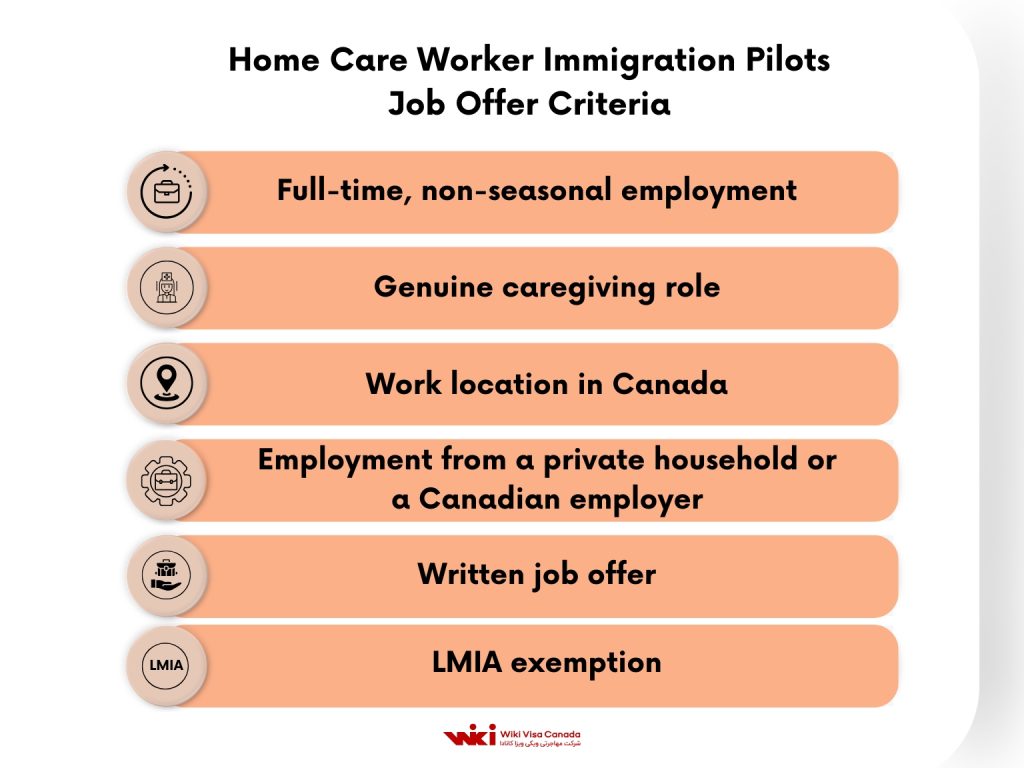
1. Home Care Worker Immigration Pilots Job Offer Specifications
For Immigration, Refugees and Citizenship Canada (IRCC) to recognize a job offer as valid, it needs to meet several key criteria:
- Full-time, non-seasonal employment. The offer must be for a minimum of 30 hours per week, ensuring continuous and stable caregiving work.
- Genuine caregiving role. The duties outlined must fall within the National Occupational Classification (NOC) codes 44100 (Home Child Care Provider) or 44101 (Home Support Worker).
- Work location in Canada. The caregiving services must be performed within Canada (excluding Quebec, which operates separate immigration programs).
- Employment from a private household or Canadian employer. The employer must be a Canadian citizen or permanent resident, offering care either for children (under 18 years of age) or individuals requiring personal assistance due to age, disability, or illness.
- Written job offer. The offer must be formalized in writing, stating job title, duties, salary, working hours, and duration, and must match IRCC’s official Job Offer Form (IMM 5983).
- LMIA exemption. Unlike most temporary foreign worker programs, job offers under the Home Care Worker Immigration Pilots are exempt from the Labour Market Impact Assessment (LMIA) requirement, simplifying the process and reducing costs for employers.
2. Employer Eligibility, Wage Standards, and LMIA Exemption
Not every household in Canada is automatically eligible to hire a foreign caregiver through the Home Care Worker Immigration Pilots. Employers need to show that they meet both the eligibility criteria and have the financial means to comply with government requirements.
Employer Eligibility in Home Care Worker Immigration Pilots:
- A Canadian citizen or permanent resident residing in Canada.
- Offering care for a specific family member, child, or dependent person.
- Able to provide proof of financial capacity to pay the offered wage (such as recent tax returns or pay slips).
Wage Standards Home Care Worker Immigration Pilots:
The offered wage must meet or exceed the median hourly wage for the occupation in the applicant’s intended province or territory, as published by the Government of Canada’s Job Bank.
For example, as of 2025:
- Home Child Care Provider (NOC 44100): approximately CAD $17–$22/hour, depending on region.
- Home Support Worker (NOC 44101): approximately CAD $18–$25/hour, depending on region.
Paying below the provincial standard can result in automatic application refusal.
LMIA Exemption of Home Care Worker Immigration Pilots:
One of the program’s most caregiver-friendly features is the LMIA exemption, which removes the need for employers to prove labor shortages or advertise the position before hiring a foreign caregiver.
This significantly reduces administrative complexity while ensuring that the Home Care Worker Immigration Pilots remain accessible to Canadian families genuinely in need of support.
This greatly simplifies the process while ensuring that the Home Care Worker Immigration Pilots are accessible to Canadian families who genuinely need help.
However, the IRCC requires clear documentation to confirm that the job is legitimate and that the employer fully understands their responsibilities under Canadian labor and immigration laws.
3. Common Mistakes that Lead to Refusals
Even if applicants meet the basic eligibility requirements, many find their applications turned down due to easily avoidable errors in the job offer or employer documentation. Here are some of the most common reasons for refusals:
- Submitting informal or incomplete job offers (missing job duties, salary, or hours).
- Using incorrect NOC codes or vague job descriptions that do not match caregiver roles.
- Employer failing to demonstrate financial capability to pay wages.
- Offering temporary, part-time, or seasonal employment, which violates full-time requirements.
- Applicants providing job offers from agencies instead of private households (not permitted under the pilots).
- Employer residing outside Canada, which automatically invalidates the offer.
To avoid these pitfalls, both applicants and employers should take the time to carefully go through IRCC’s official checklist and make sure all employment details are clearly outlined and can be verified.
4. Job Offer & Employer Checklist of Home Care Worker Immigration Pilots
This handy checklist is designed to help applicants and employers ensure their submission aligns with IRCC’s standards for the Home Care Worker Immigration Pilots:
For Employers | For Applicants |
Canadian citizen or PR offering in-home care | Verify job offer matches the correct NOC (44100 or 44101) |
Provide a written offer using the IRCC form IMM 5983 | Ensure job offer is full-time (30+ hrs/week) |
Demonstrate financial capacity (tax return, pay slip) | Include the job offer letter and IMM 5983 in the application |
Meet provincial wage standards | Confirm the employer’s identity and residence in Canada |
Offer employment within Canada (outside Quebec) | Avoid agency-mediated offers (must be direct household) |
Cost of Applying to the Home Care Worker Immigration Pilots
Applying through the Home Care Worker Immigration Pilots involves several government and supporting fees. These costs vary slightly depending on whether you apply through the Home Child Care Provider Pilot (HCCP) or the Home Support Worker Pilot (HSWP).
Table of Home Care Worker Immigration Pilots Fees
Category | Home Child Care Provider Pilot (HCCP) | Home Support Worker Pilot (HSWP) | Description / Notes |
Application Processing Fee (Principal Applicant) | CAD $850 | CAD $850 | Paid to IRCC when submitting your application for permanent residence. |
Right of Permanent Residence Fee (RPRF) | CAD $575 | CAD $575 | Payable once the application is approved; mandatory for finalizing PR status. |
Work Permit Application Fee | CAD $155 | CAD $155 | Required if you apply for an occupation-restricted open work permit. |
Biometrics Fee | CAD $85 (individual) | CAD $85 (individual) | Includes fingerprinting and photo submission for background checks. |
Spouse or Partner Application Fee (if applicable) | CAD $850 | CAD $850 | Optional if including a spouse in your application. |
Dependent Child Fee (per child) | CAD $230 | CAD $230 | For each dependent child included in the PR application. |
Educational Credential Assessment (ECA) | CAD $200–$250 | CAD $200–$250 | Required for verifying foreign education credentials (paid to ECA agencies, not IRCC). |
Language Test Fee (IELTS/CELPIP) | CAD $250–$350 | CAD $250–$350 | Required for proof of language proficiency; cost varies by testing center. |
Medical Examination | CAD $150–$300 | CAD $150–$300 | Mandatory medical test by an IRCC-approved physician. |
Total Estimated Cost (Single Applicant) | CAD $2,645 – $3,015 | CAD $2,645 – $3,015 | Approximate total including mandatory and standard supporting fees. |
Note:
These figures represent estimated costs as of 2025, based on IRCC’s official fee schedule and average third-party service rates. Applicants should always confirm the latest fees directly on the IRCC official website before applying.
What’s New in Home Care Worker Immigration Pilots for 2026
In June 2024, Canada announced a significant change in its caregiver immigration programs. The Home Child Care Provider Pilot and the Home Support Worker Pilot, which had been temporary programs, officially closed to new applicants on June 17, 2024. These pilots are now replaced with permanent immigration pathways that make it easier for caregivers to become permanent residents as soon as they arrive.
Direct Permanent Residency (PR) Upon Arrival
Unlike the previous two-step process, where caregivers first got a temporary work permit and then applied for PR, the new system allows eligible caregivers to come to Canada as permanent residents. This change removes the need for a work permit and simplifies the transition to permanent status.
Simplified Eligibility Criteria
The eligibility requirements have been simplified to make the application process easier:
- Job Offer: Applicants must have a full-time job offer in home child care or home support.
- Work Experience or Training: Relevant experience or training in the caregiving field is required.
- Language Proficiency: Applicants must meet the Canadian Language Benchmark (CLB) 5 in all four abilities (reading, writing, speaking, listening).
- Education: A high school diploma or equivalent is necessary.
- Admissibility: Applicants must be admissible to Canada.
These streamlined requirements are meant to lower barriers and speed up the application process.
Open Work Permit for Family Members
Spouses, common-law partners, and dependent children of applicants may qualify for open work permits or study permits. This allows them to work or study in Canada while the main applicant settles. This rule supports family reunification and aids in integrating into Canadian society.
Removal of Certain Requirements
Some previous requirements have been removed to make access easier:
- No Labour Market Impact Assessment (LMIA) Required: Employers no longer need to obtain an LMIA to hire caregivers under this program.
- No Need for Temporary Work Permit: Applicants can apply directly for PR without first obtaining a temporary work permit.
These changes aim to reduce the administrative burden for both employers and applicants.
Projections and Trends
While specific admission targets for the new permanent pilots have not been shared publicly, the switch to direct PR is expected to increase the number of caregivers moving to Canada. This change supports Canada’s ongoing efforts to address labor shortages in the caregiving sector and help family reunification.
For detailed information on eligibility, application procedures, and to start your application, please visit the official IRCC page.
Appendix H: Home Care Worker Immigration Pilots Economic Impact
The Home Care Worker Immigration Pilots (HCWIP) are crucial to Canada’s immigration strategy. They aim to address significant labor shortages in essential sectors like healthcare and child care.
Strategic Alignment with Canada’s Immigration Goals
Launched by Immigration, Refugees and Citizenship Canada (IRCC), these pilots seek to attract skilled caregivers. These caregivers can meet the needs of an aging population and the increasing demand for in-home care services. By providing a direct route to permanent residence, the HCWIP aligns with Canada’s goals to boost labor force participation and support family reunification.
Addressing Labor Shortages in Healthcare and Child Care
Canada is facing notable labor shortages in healthcare and child care. The HCWIP aims to ease these shortages by allowing the immigration of qualified caregivers who provide essential services to families and individuals. This initiative is timely, as the demand for home care services is rising due to an aging population and a stronger preference for in-home care options.
Future Trends and Program Expansion
In the future, there may be opportunities to expand similar programs to tackle labor shortages in other fields. The HCWIP’s success could serve as a model for creating other immigration pathways focused on specific jobs with labor shortages. However, the continuing success of these programs will depend on regular evaluation and adjustments to meet the evolving needs of the Canadian labor market.
Frequently Asked Questions (FAQ)
Q1: Is the Home Care Worker Immigration Pilot still open in 2025?
Yes, the Home Care Worker Immigration Pilots are open for applications. The program started on March 31, 2025, and is accepting applications through the “Workers in Canada” stream.
Q2: Can I apply for PR after 12 months?
Under the new pilots, applicants can apply for permanent residence (PR) upon arrival in Canada. This removes the previous requirement of 12 months of work experience.
Q3: What is the difference between caregiver and home care worker programs?
The term “caregiver” usually refers to people providing personal care to children, elderly individuals, or those with disabilities. “Home care worker” specifically refers to professionals who provide in-home support services. The HCWIP includes both categories and offers pathways to PR for qualified individuals in these roles.
Q4: Do I need an LMIA for this program?
No, the HCWIP is exempt from the Labour Market Impact Assessment (LMIA). Employers do not have to show that no Canadian citizen or permanent resident is available for the position.
Q5: Can my family come with me?
Yes, spouses, common-law partners, and dependent children of applicants may qualify for open work permits or study permits. This allows them to work or study in Canada while the main applicant settles in.
Conclusion
The Home Care Worker Immigration Pilots offer an easy way for skilled caregivers to get permanent residency in Canada while addressing major labor shortages in child care and home support services. These pilots provide flexible work permits, family inclusion, and a clear path to settlement. They support applicants and improve Canada’s caregiving workforce.
Potential applicants should stay informed about the latest IRCC news and prepare their documents carefully to ensure a smooth application process. With proper planning and support, joining the Home Care Worker Immigration Pilots can lead to lasting professional growth, family reunification, and a permanent life in Canada.
WikiVisa Canada, a trusted provider of immigration guidance, is committed to helping applicants navigate the program effectively. They work to ensure that every eligible caregiver can contribute to Canada’s future care workforce.